



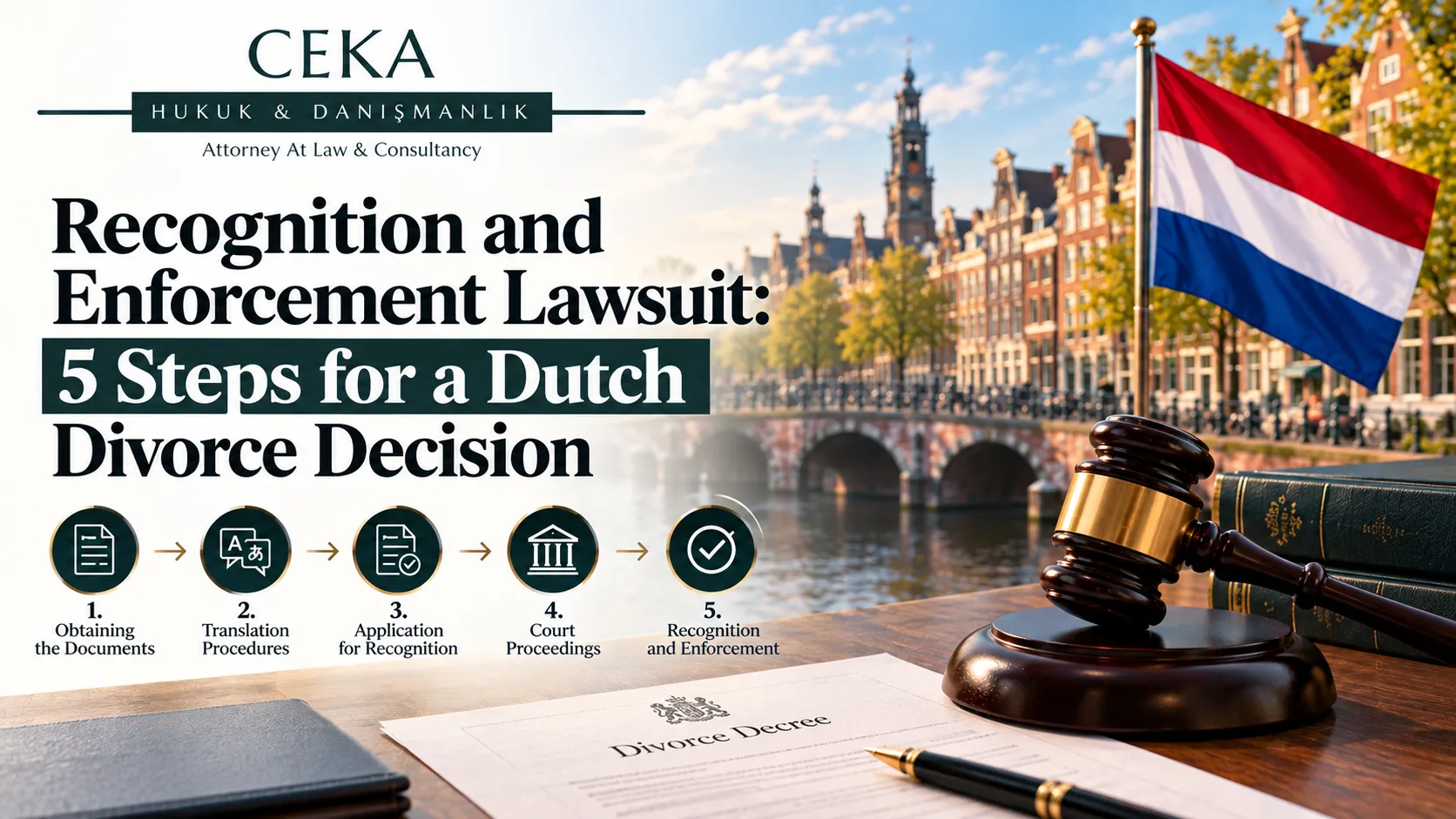
Recognize a Dutch Divorce Judgment in Turkey: 5 Important Steps
If you divorced in the Netherlands, your marital status may not automatically be updated in Turkish civil registry records. Depending on the circumstances, administrative registration or judicial recognition may be required. This guide explains the key steps, documents and legal considerations.
A divorce granted in the Netherlands does not necessarily mean that your marital status has been updated in Turkey. If Turkish civil registry records still show you as married, this may create difficulties in future marriage procedures and other legal or administrative matters. The correct route depends on the foreign decision, the parties’ circumstances and the applicable Turkish legislation.
Why Must a Dutch Divorce Judgment Be Recognized in Turkey?
Recognition or registration may be necessary for a Dutch divorce decision to produce the relevant legal effects in Turkey. An outdated civil status record can cause practical issues in official transactions. If the foreign decision also includes provisions about child custody, maintenance or financial obligations, those provisions should be reviewed separately.
The legal framework may include Article 27/A of Turkish Civil Registration Services Law No. 5490, which provides for registration of certain foreign divorce decisions if statutory conditions are met, and Law No. 5718 on International Private and Civil Procedure Law for judicial recognition and enforcement. The applicable route should be assessed in light of the current legislation and the specific decision.
Consult the official Turkish legislation portal for legislation and amendments.
Administrative Registration or Recognition Proceedings?
A court case may not be necessary in every situation. If the legal conditions are satisfied, an administrative registration route may be available. Where those conditions are not met, or where judicial recognition or enforcement of additional provisions is required, proceedings before a Turkish court may need to be considered.
| Point to consider | Administrative registration | Judicial proceedings |
|---|---|---|
| Purpose | Registration of a qualifying foreign divorce decision under the relevant statutory procedure | Recognition of a foreign judgment and, where appropriate, enforcement of relevant provisions |
| Availability | Only if the legal requirements for this route are met | May be required if administrative registration is unavailable or insufficient |
| Documents | Official decision and supporting documents required by the competent authority | Judgment, evidence of finality and other documents required by the court |
| Case-specific review | Required before filing | Required before filing |
Step 1: Review the Dutch Divorce Judgment
Begin by reviewing the full judgment and determining whether it is final under the applicable Dutch law. Identify the authority that issued the decision and check whether it deals only with the dissolution of the marriage or also includes custody, maintenance or financial orders.
- Obtain a complete official copy of the decision.
- Confirm how the decision’s finality should be evidenced.
- Review whether any additional orders require separate consideration in Turkey.
- Check the parties’ names and personal details for consistency across documents.
Learn more about our Recognition and Enforcement Proceedings services.
Step 2: Prepare the Required Documents
Document requirements depend on the procedure and the competent authority. Documents issued in the Netherlands may require authentication, an apostille or a certified Turkish translation, depending on the applicable rules.
- A complete official copy of the Dutch divorce judgment.
- Evidence of finality, where required.
- An apostille or other authentication, if applicable.
- A certified Turkish translation, where required.
- Identity documents and relevant civil status records.
- A power of attorney if a lawyer is appointed, in the required form.
- Any additional documents requested by the competent authority or court.
For consular information, visit the official Consular Procedures portal.
Step 3: Understand Recognition and Enforcement
Recognition and enforcement are distinct legal concepts. Recognition generally concerns accepting the legal effects of a foreign judgment in Turkey. In a divorce matter, this may allow the divorce decision to be taken into account for relevant legal purposes, subject to the applicable requirements.
Enforcement concerns whether particular obligations in a foreign judgment can be enforced in Turkey. Provisions involving maintenance, financial obligations or other matters may require a separate assessment and, where applicable, an enforceability procedure. The treatment of custody and contact arrangements also depends on the decision and the relevant legal rules.
See our page on Recognition and Enforcement Proceedings for further information.
Step 4: Determine the Correct Procedure
Article 27/A of Law No. 5490 may provide an administrative route for qualifying foreign divorce decisions, subject to statutory conditions. If those conditions are not satisfied, or if the relief sought requires judicial proceedings, recognition under Law No. 5718 may need to be considered.
The availability of an administrative procedure should not be assumed without reviewing the decision and the parties’ circumstances. Official civil registration information is available from the Directorate General of Civil Registration and Nationality.
Step 5: Submit a Complete Application
Once the decision and documents have been reviewed, prepare the application for the appropriate administrative authority or court. A complete and consistent file can help reduce avoidable delays, although additional documents or explanations may still be requested.
- Confirm that the full judgment is included.
- Include proof of finality if required.
- Check translations and authentication requirements.
- Ensure names and personal details are consistent.
- Choose the appropriate administrative or judicial route.
- Include identity documents and a properly prepared power of attorney, if applicable.
Processing times vary depending on the procedure, the completeness of the documents and the circumstances of the case. No single timeline can be guaranteed for every application.
If your matter also involves divorce or child custody, visit our pages on Divorce and Child Custody Cases and Family Law.
Common Mistakes to Avoid
- Failing to establish that the judgment is final, where required.
- Submitting incomplete or unsuitable translations.
- Overlooking a required apostille or authentication.
- Selecting an administrative route without confirming eligibility.
- Assuming that all additional orders are automatically enforceable.
- Providing documents with inconsistent names or personal details.
- Submitting an application before checking the current requirements.
Frequently Asked Questions
Does every Dutch divorce judgment require court proceedings in Turkey?
No. Administrative registration may be possible if the statutory conditions are met. Otherwise, judicial recognition may need to be considered. The correct route depends on the case.
Which documents are generally required?
The foreign judgment is central. Depending on the procedure, evidence of finality, a certified translation, an apostille or other authentication, identity documents and a power of attorney may also be required.
How long does the process take?
There is no single timeframe for every case. The duration depends on the chosen procedure, document completeness, the authority or court involved and any additional procedural steps.
Can a lawyer handle the procedure?
A lawyer may assist in reviewing the judgment, determining the appropriate route, preparing the application and representing the client where permitted. Any power of attorney should be prepared in the required form.
Are custody and maintenance orders automatically recognized?
Not necessarily. The legal effect of additional provisions must be assessed individually, and some may require a separate procedure before they can be enforced in Turkey.
Legal Assistance With Dutch Divorce Judgments
Discuss Your Case With CEKA Hukuk & Danışmanlık
Recognizing a Dutch divorce judgment in Turkey may involve important documentary and procedural requirements. The appropriate route depends on the judgment, the available documents and the circumstances of the parties.
Learn more about our Areas of Service, meet Our Team, or visit our Home page.
For related matters, explore Recognition and Enforcement Proceedings, Divorce and Child Custody Cases and Family Law.
Official Sources
- Turkish Legislation Information System
- Consular Procedures of the Republic of Türkiye
- Directorate General of Civil Registration and Nationality
- Dutch Government Legislation Portal
Disclaimer: This article is provided for general informational purposes only and does not constitute individual legal advice. The applicable procedure and requirements depend on the facts of the case and the law in force at the relevant time.