



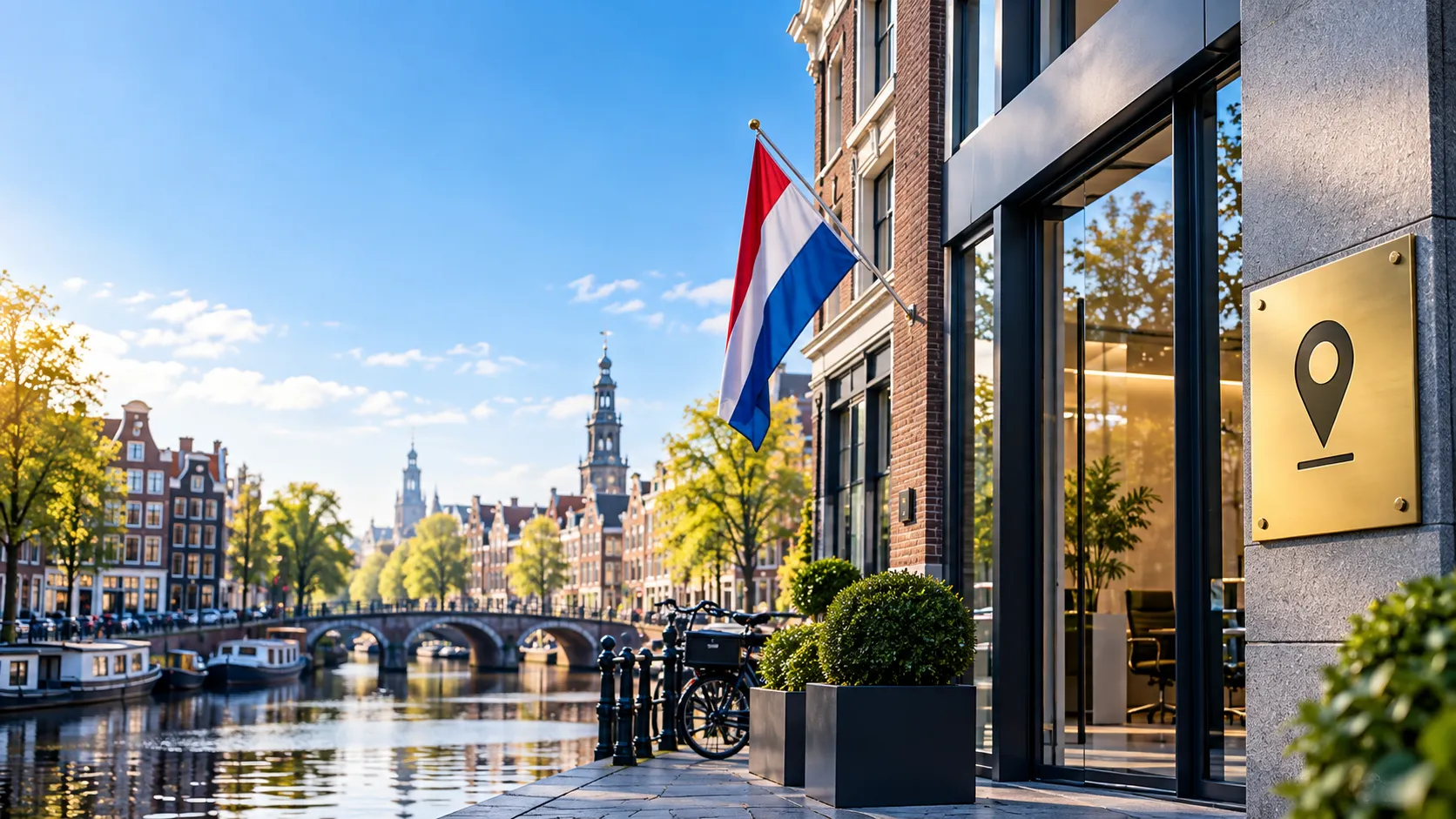
Starting a BV in the Netherlands: Why the Business Address Matters
If you want to establish a private limited company in the Netherlands (a Besloten Vennootschap, or BV), one of the first issues to resolve is the company’s business address. The Dutch Chamber of Commerce, known as the Kamer van Koophandel (KVK), generally requires an actual business address (vestigingsadres) for registration. A PO box alone is not sufficient. If the address has not been arranged, the notarial incorporation, KVK registration and tax registration may be delayed.
If you are also planning to live in the Netherlands, distinguish the company’s business address from your personal residential address. They serve different purposes and should be considered separately from the outset.
This guide explains the main address requirements for a Dutch BV, the options available to founders living abroad, and how the business address relates to the notary process, municipal registration and residence permits.
What are the main steps in setting up a Dutch BV?
A BV is a common Dutch company structure and is broadly comparable in some respects to a limited liability company in other countries. Incorporation typically involves the following steps:
- Preparing the company’s articles of association.
- Having a Dutch civil-law notary prepare the deed of incorporation.
- Registering the company with the KVK and recording the ultimate beneficial owners (UBOs), where required.
- Arranging the relevant registrations with the Dutch Tax Administration (Belastingdienst).
The business address should be settled at the beginning, not left until the final stage. It may be needed during the incorporation process and should be discussed with the notary before the appointment.
Why is the business address so important?
The address recorded with the KVK must meet the applicable requirements. It is not enough simply to have somewhere that can receive mail; you may also need to show that the address is suitable for business registration and that you are entitled to use it.
- It must be a real address. A physical location is generally required. A PO box (postbus) does not replace the company’s business address.
- Your right to use the address may need to be documented. Depending on the circumstances, evidence could include a signed lease, ownership documentation or written permission from the property owner.
- Business use must be permitted. Local planning rules, the lease or the rules of a homeowners’ association may restrict business activity at the address.
The address is more than a field on a form. The notary may ask about it before incorporation, the KVK may check the details, and official correspondence may be sent there. An unsuitable or insufficiently documented address can delay registration or prevent it from being completed.
Which types of address may be used?
| Address type | Can it be used? | What to check |
|---|---|---|
| Your own home | Yes, subject to conditions | Ownership or lease terms, local rules and any homeowners’ association requirements must allow the intended business use. |
| Rented office or commercial premises | Yes | Have a valid, signed lease available. |
| Virtual office or business-address service | Possibly, depending on the service | Confirm that the provider supplies a business address suitable for registration and can document the arrangement in a contract. A mail-only service may not be enough. |
| PO box (postbus) | No, not as the business address | It may be used for correspondence, but it does not replace an actual business address for registration. |
Before paying for a virtual office, ask the provider to confirm in writing what address is supplied and whether it is suitable for the intended KVK registration. The specific arrangement should be checked for your circumstances.
Can I establish a BV without living in the Netherlands?
In general, a founder or director does not have to live in the Netherlands solely because a BV is being established. The company must, however, have a valid business address in the Netherlands. The founder’s personal place of residence and the company’s registered business address are separate matters.
Depending on the circumstances, the notarial incorporation may be completed in different ways:
- In person before the notary: You travel to the Netherlands and sign the deed in person.
- Using a power of attorney: In certain cases, a representative may act under a power of attorney. If the document is prepared abroad, notarisation, an apostille and a translation may be required. Ask the Dutch notary which form is acceptable.
- Online incorporation: A digital process may be available for certain BV incorporations, subject to identity checks and the notary’s assessment. It is not necessarily available or suitable in every case.
The notary handling the incorporation will confirm which route is available and which documents are needed. Ask for these requirements in writing before making arrangements.
How does the business address relate to residence permits?
Establishing a BV does not automatically give you the right to live or work in the Netherlands. A residence permit is a separate matter, and your personal residential address should not be confused with the company’s business address.
- People who intend to live in the Netherlands for more than four months generally need to register with their municipality in the Personal Records Database (BRP), usually within five days of arrival.
- People staying for shorter periods or who are not registered as residents may, depending on their circumstances, register in the Non-residents Records Database (RNI) to obtain a citizen service number (BSN).
- For many non-EU/EEA nationals who plan to stay for more than 90 days, a residence permit and, in some cases, an entry visa (MVV) may be required. The exact requirements depend on nationality and the purpose of the stay.
- If you plan to apply for residence based on entrepreneurship or self-employment, review the requirements for the business, your personal accommodation and your immigration status together.
If you intend to live in the Netherlands, plan for two separate matters: the BV’s business address and your personal residential address for municipal registration. One does not replace the other.
Common business-address mistakes
- Treating a PO box or mail-forwarding service as a full business address.
- Providing a lease that has not been signed by all necessary parties.
- Failing to obtain permission from the landlord or homeowners’ association where it is required.
- Continuing to use a former Dutch residential address after the right to use it has ended.
- Waiting until after the notary appointment to resolve the address issue.
- Assuming that the requirements from an earlier incorporation will necessarily apply to a new case.
- Failing to notify the KVK promptly when the business address changes.
Why can incorporation be delayed, and who is responsible?
Cross-border incorporations can be delayed by appointment availability, missing documents, certified translations or apostille procedures. Agreeing on responsibilities in advance can help reduce avoidable delays.
| Person involved | Typical responsibilities |
|---|---|
| Legal adviser or lawyer | Maps out the process, prepares documents, coordinates with the notary and local specialists, and explains the required evidence. |
| Notary | Checks identity and relevant details, prepares the deed of incorporation and initiates the required registration steps. |
| Founder | Provides identity, address and lease documents on time, attends appointments and appears in person if required. |
The founder must provide personal documents and evidence relating to the business or residential address. An adviser cannot create those personal records on the founder’s behalf. It is sensible to set out responsibilities in the engagement agreement.
Checklist before incorporating a BV
- Is the business address confirmed, and is it an actual address?
- Is a signed lease, ownership document or written permission from the property owner available?
- Do the lease, local rules and any homeowners’ association requirements permit the intended business use?
- If using a virtual office, has the provider confirmed in writing the address and its suitability for the intended KVK registration?
- Has the notary confirmed whether the incorporation can be completed in person, by power of attorney or online?
- If a move to the Netherlands is planned, have the personal residential address and any BRP registration requirements been considered?
- Has enough time been allowed for certified translations and apostilles?
Frequently asked questions
Can I register a Dutch BV using a PO box?
Can I establish a BV if I do not live in the Netherlands?
Does the KVK accept a virtual office address?
Will setting up a BV automatically give me the right to live in the Netherlands?
Do I have to attend the notary in person?
This article is for general information only and does not constitute legal advice. Requirements may change and can depend on the individual case. Before incorporating, confirm the current rules with the relevant Dutch notary and official sources.
Official and further sources
- KVK – Registering a business location
- Government of the Netherlands – When must I register in the BRP?
- Ondernemersplein – Foreign entrepreneurs in the Netherlands
- Notaris.nl – Setting up a BV remotely
- Hekkelman – How to establish a BV
- Multiraedt – Establishing a BV without a Dutch address
- Virtualoffice4u – KVK business-address requirements