



How can we help you?
You can call us.
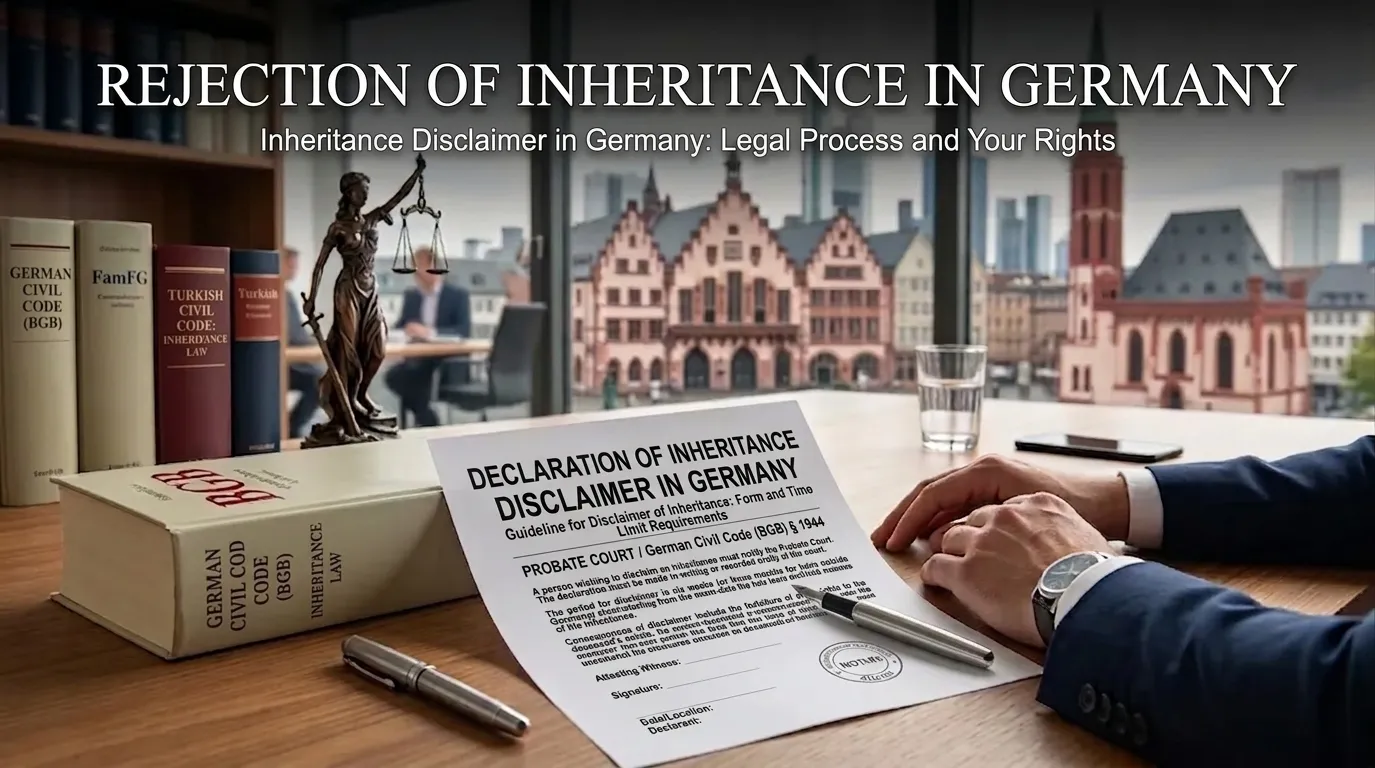
Renouncing an Inheritance in Germany: What About Assets in Turkey?
Av. Cihat KAYA | CEKA Law and Legal Consultancy | 25 September 2026
When a relative dies in Germany leaving debts that exceed the value of their assets, renouncing the inheritance may appear to be the obvious solution. Many families living in Germany complete the renunciation process before the German probate court (Nachlassgericht) and assume that the matter is therefore settled.
However, where the deceased was a Turkish citizen, a renunciation made in Germany does not automatically cover assets located in Turkey or movable assets subject to Turkish law.
An heir who does not make a separate renunciation under Turkish law may, depending on the circumstances, be treated as having accepted the inheritance in Turkey. This can expose the heir to the risk of personal liability for the deceased’s debts.
This article explains why this distinction matters, how the renunciation deadlines work in Germany and Turkey, and which mistakes heirs should avoid in cross-border inheritance cases.
Which Law Applies to the Estate of a Turkish Citizen Who Dies in Germany?
The answer lies in the Consular Convention between Turkey and Germany of 28 May 1929 and the Succession Agreement attached to it. Under Article 14 of the Agreement, movable assets are generally governed by the law of the deceased’s nationality at the time of death. Immovable property, on the other hand, is governed by the law of the country in which the property is located.
As a result, a single estate may be subject to two different legal systems. German legal terminology refers to this situation as Nachlassspaltung, meaning a division of the estate between different legal systems.
For a deceased Turkish citizen, the general framework can be summarised as follows:
| Type of Asset | Applicable Law | Where the Renunciation Is Made |
|---|---|---|
| Movable assets, including bank accounts in Germany | Turkish law | Civil Court of Peace in Turkey (Sulh Hukuk Mahkemesi) |
| Immovable property in Turkey | Turkish law | Civil Court of Peace in Turkey |
| Immovable property in Germany | German law | German probate court (Nachlassgericht) |
The EU Succession Regulation (Regulation (EU) No. 650/2012), which has applied in EU Member States since 2015, does not necessarily displace this framework. Article 75 preserves the application of certain existing international agreements between Member States and third countries.
Turkish private international law reaches a similar result. Under Article 20 of the Turkish Private International Law Act (MÖHUK No. 5718), succession is generally governed by the deceased’s national law, while immovable property located in Turkey remains subject to Turkish law.
The analysis may be different where the deceased held dual nationality or had renounced Turkish citizenship before death, for example as a Mavi Kart holder. Such cases should be assessed individually.
How Do You Renounce an Inheritance in Germany?
Is the German Renunciation Deadline Six Weeks or Six Months?
Under the German Civil Code (Bürgerliches Gesetzbuch – BGB), the general period for renouncing an inheritance is six weeks (BGB § 1944).
The period is extended to six months where the deceased’s last habitual residence was exclusively abroad or where the heir was abroad when the period began, subject to the statutory requirements.
For heirs living in Turkey, the six-month period may therefore become relevant in appropriate cases. The deadline generally begins when the heir becomes aware of both the death and the fact that they have become an heir.
Where and How Must the Renunciation Be Made?
The renunciation must be made before the competent German probate court. This is generally the Nachlassgericht associated with the deceased’s last place of residence.
The declaration may be recorded by the court or submitted in writing with an officially certified signature. Persons living in Turkey may also use the German Embassy in Ankara or the German Consulates General in Istanbul, Izmir or Antalya for the relevant signature certification procedure.
Renunciation Through a Lawyer
An heir does not necessarily have to travel to Germany. In certain circumstances, the inheritance can be renounced through a lawyer acting under an appropriate power of attorney.
The power of attorney must satisfy the applicable formal requirements and must be submitted within the renunciation period (BGB § 1945(3)). A standard general power of attorney may not be sufficient for this purpose.
A special power of attorney executed before a Turkish notary, appropriately apostilled and accompanied by a sworn German translation, may be used depending on the circumstances.
Two further points are particularly important. First, an heir who applies for a German certificate of inheritance (Erbschein) may, depending on the circumstances, be regarded as having accepted the inheritance, after which renunciation may no longer be available.
Second, when an heir renounces an inheritance in Germany, the inheritance may pass to the next person entitled to inherit, often the renouncing heir’s children. Where the estate is insolvent, separate renunciation procedures may therefore be required for the children as well.
Renouncing an Inheritance in Turkey: Deadline and Procedure
Under Articles 605 et seq. of the Turkish Civil Code (Türk Medeni Kanunu), legal heirs generally have three months to renounce an inheritance. The period begins when the heir learns of the death, subject to the statutory rules (TMK Article 606).
Where there is a justified reason, the Civil Court of Peace may extend the period or grant a new period (TMK Article 615).
The renunciation is made before the Sulh Hukuk Mahkemesi, either orally or in writing. The court records the declaration and enters it in the relevant register (TMK Article 609).
Where the deceased died abroad, the competent Turkish court will depend on the circumstances, including the deceased’s last place of residence in Turkey and, where applicable, the location of estate assets.
Heirs must also be careful not to take actions that may result in the loss of the right to renounce. An heir who interferes with the estate beyond ordinary administration, conceals estate assets or appropriates them may lose the right of renunciation under TMK Article 610.
What Happens If the Three-Month Deadline in Turkey Has Been Missed?
Where the estate was clearly insolvent at the time of death or its insolvency has been officially established, the inheritance may be deemed to have been renounced under TMK Article 605(2). This is commonly referred to as statutory or deemed renunciation (hükmen ret).
A claim seeking recognition of deemed renunciation is not subject to the ordinary three-month deadline. However, the heir may need to establish that the estate was insolvent and must not have interfered with the estate in a manner inconsistent with renunciation.
For this reason, deemed renunciation should not be treated as a substitute for making a timely renunciation where the heir is aware of the deadline and intends to reject the inheritance.
Why Does Renunciation in Germany Not Automatically Cover Assets in Turkey?
A renunciation made before a German probate court produces its legal effects within the scope of the applicable German succession rules. This does not automatically mean that the declaration will also be treated as a Turkish-law renunciation for assets governed by Turkish law.
Turkish law provides its own procedure for renunciation before the Sulh Hukuk Mahkemesi, including the recording of the declaration in the relevant register. A declaration made before a foreign court is not automatically treated as satisfying these Turkish procedural requirements.
This distinction can become particularly important in relation to land registry records, bank accounts and enforcement proceedings in Turkey. Turkish authorities and institutions may require documentation demonstrating the heir’s status under Turkish law.
The difference between the deadlines is another major practical issue. An heir living in Turkey may rely on the German six-month period while the Turkish three-month period is already running.
The reverse situation can also arise. A renunciation made in Turkey does not necessarily resolve the position concerning immovable property in Germany, where German succession rules and the German probate court may remain relevant.
Key Point:
Where an estate is heavily indebted and assets are located in both Germany and Turkey, heirs may need to complete renunciation procedures in both jurisdictions, within the applicable deadlines for each.
Germany and Turkey: Inheritance Renunciation Deadlines Compared
| Issue | Germany | Turkey |
|---|---|---|
| Relevant assets | Immovable property in Germany | Movable assets and immovable property in Turkey |
| Competent authority | German probate court (Nachlassgericht) | Civil Court of Peace (Sulh Hukuk Mahkemesi) |
| Deadline | Six weeks; six months in certain international circumstances | Three months |
| Starting point | Knowledge of the death and the status as heir | Knowledge of the death, subject to statutory rules |
| Form | Court record or officially certified declaration | Oral or written declaration recorded by the court |
| If all heirs renounce | The inheritance passes according to the applicable German succession rules | The estate is dealt with under the applicable Turkish succession and insolvency rules |
What Should Heirs Pay Particular Attention To?
Frequently Asked Questions
I Renounced the Inheritance in Germany. Do I Also Need to Renounce It in Turkey?
Where the deceased was a Turkish citizen, a separate Turkish-law procedure may be necessary for movable assets and immovable property located in Turkey. A German renunciation does not automatically create a corresponding entry in the Turkish inheritance records.
What Is the Deadline for Renouncing an Inheritance in Germany?
The general period is six weeks. In certain cases involving an international element, including where the deceased’s last residence was exclusively abroad or the heir was abroad when the period began, the period may be six months. The exact starting date and applicable period must be assessed under BGB § 1944.
What Is the Deadline for Renouncing an Inheritance in Turkey?
The general period for legal heirs is three months and begins when the heir learns of the death, subject to the statutory rules. In justified circumstances, the court may extend the period or grant a new period.
How Can I Renounce an Inheritance in Germany While Living in Turkey?
Depending on the circumstances, the declaration may be made using the relevant German diplomatic or consular procedures in Turkey and submitted to the competent German probate court. Another option may be to appoint a German lawyer through an appropriately executed power of attorney, subject to the applicable formalities.
What If I Missed the Renunciation Deadline?
In Turkey, deemed renunciation (hükmen ret) may be relevant where the estate was insolvent at the time of death or its insolvency has been officially established. In Germany, certain circumstances involving a mistake may give rise to an option to challenge an acceptance under the applicable rules. These remedies are highly fact-specific and should be assessed without delay.
Conclusion
The estate of a Turkish citizen who dies in Germany can involve the laws of both Germany and Turkey. A renunciation made in Germany may therefore deal with only part of the estate and may not automatically resolve the position concerning assets governed by Turkish law.
Where an estate is burdened with significant debts and assets are located in both countries, heirs should carefully determine which legal system applies to each asset and calculate the applicable deadlines separately. In some cases, renunciation procedures may need to be completed in both Germany and Turkey.
Legal Disclaimer: This article is provided for general information purposes only and does not constitute legal advice. Cross-border inheritance matters must be assessed individually, taking into account factors including the deceased’s nationality, the location of the assets, the applicable succession rules and the date on which the heir became aware of the death and inheritance.
Av. Cihat KAYA | CEKA Law and Legal Consultancy
25 September 2026